Old Gods, No Masters: Queer Resistance and Utopian Ideation in Marion Zimmer Bradley’s The Mists of Avalon
University of Suffolk
School of Social Sciences and Humanities
BA (Hons) English
This dissertation is submitted towards the assessment for the award of BA (Hons) English
I confirm that the work presented is all my own work.
Any other sources of information used have been clearly acknowledged or referenced.
Permission to reproduce information has been sought and approved where appropriate.
Signed: Kizzy Barrow Date: 03/06/21
Acknowledgements
I would like to thank the queers: past, present and future; the people who are committed to queering everything from Bond to the hardcore scene to the country house – and particularly their everyday radical acts of existence. It is upon the foundations of queer kinship and community that this dissertation has been built, and a good deal of those foundations can be found in the housing co-operative that has supported me in this last year’s work. So, all my love and gratitude to my friends and family, and to the punks, pranksters and cultural gangsters of RCHC.
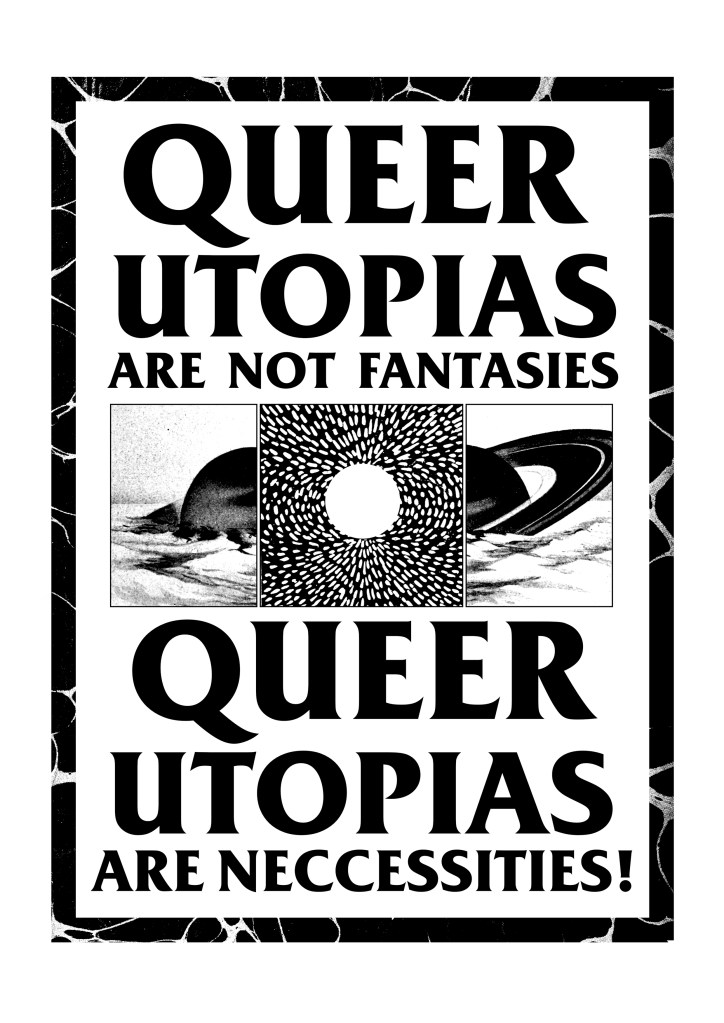
Additional thanks go to CJ of Black Lodge Press for their radical artwork in general, and specifically their permission to use Queer Utopias Are Neccessities! on the title page of this dissertation.
Note on spellings
The Arthurian legends have been written and re-written by many generations of authors spanning multiple centuries and several geographic and cultural contexts. The varied names that authors have given to characters universally known to Arthuriana have a rich and fascinating history of their own that this dissertation unfortunately does not have the time to devote to considering. However, some variations in spelling appear in these pages, which adhere to the following logic: spellings are used in deference to the chosen spelling of the author being discussed in the present moment. For example, Bradley’s narrator is referred to as Morgaine; where, in reference to conventional Arthuriana or Tennyson’s Idylls of the King, the spelling Morgan or Morgan le Fay may be used. Likewise and so on for the spellings of Avalon/Avilion, Lancelet/Lancelot, Gwenhwyfar/Guinevere.
Introduction
In the attempt to view Avalon through a queer lens, it is fundamental to acknowledge that the Arthurian academic gaze has been traditionally defined by a monoculture of whiteness, cis-heterosexuality, and political orthodoxy; and it is vital to recognise the symbolic power imbued in the Arthurian legends themselves. The legends of King Arthur are hugely significant to the European and British cultural and national identity, with a similar legacy to that of the traditional fairy tale. For generations they have reproduced an apparent sense of the natural order of things, they engender a simplified mythology of human existence. What these stories speak of, in their most essential sense, is the motivations and behaviours of individuals- a ‘truth’ of being- and so, concentrated within these legends are the supposedly fundamental trials and pursuits of humanity: marriage and infidelity, procreation and lineage, power and loyalty. Their characters are inscribed with heteronormative ideologies of masculinity and femininity; consider Tennyson’s Victorian cast of characters: noble Arthur (the masculine ideal), and his marriage to fair Guinevere. Their symbolically threatening counterparts: the witty seductress Vivien and treacherous Mordred. The various revivals of Arthur, and of the Medieval romance, and their subsequent interpretations of desire, power and legacy, have much to reveal about the construction and experience of gendered, sexual and national identity. So, to look at the Arthurian legend beyond the heteronormative requires a commitment to the fact that it is not just the hegemony of cis-heterosexuality that must be disrupted, but the rhetoric of patriarchy, imperialism and hierarchy that have shaped a collective understanding of the Matter of Britain over the ages.
Building, as ever, on feminist groundwork, queer Medievalists have made recent efforts to renegotiate the pre-modern as a generative historical location for queerness, and have subsequently turned up research that has greatly enriched the various academic landscapes that queer theory ploughs. It is in this spirit that this dissertation utilises contemporary queer and Anarchist theory to locate the foundations of utopia in Marion Zimmer Bradley’s 1985 feminist Arthurian fantasy The Mists of Avalon. The events and characters that this dissertation will examine in the following chapters are evidence that, ultimately, Mists subscribes to no essentialist parameters. It is a fantasy world in flux, in the process of change and becoming and thus, is fertile ground for queering. In looking to the intersection of the ideologies that have left an indelible mark on Arthuriana is where this dissertation’s focus is born: a counter reading of the Arthurian legend which considers the possibilities of queer utopianism underpinned by anarchist social theory.
Mists’ Morgaine is the primary character this dissertation will analyse. In recent scholarship, literature and on the screen, Morgaine has been taken to symbolise a character that liberates women. Her attributes and behaviours, and her disruptions of the chivalric court have led to her being reclaimed as a feminist icon. It is easy to see the motivation for this valiant reclaiming of Morgaine, as for Monmouth and Malory, through Tennyson, to Bradley- the varied depictions of Morgaine and her siblings betray a fundamental societal fear of women’s agency. She has traditionally been inscribed with the worst and most polarised iterations of non-masculinity. She is Arthur’s perennial adversary, who, in her more comedic appearances, clumsily obstructs the chivalric hegemony and in her more sinister, brings down destruction and dissolution upon all Britain. So, it is with a perfect logic of inversion that feminist thought has radicalised Morgaine’s mischief making. This radicalism is particularly evidenced in Bradley’s Mists, where Morgaine is portrayed as a politically influential character who is, unlike her Medieval and Victorian ancestors, is not reliant upon nor indebted to a male mentor for her knowledge and social power.
Bradley’s reimagined Avalon is Morgaine’s liberatory foundation, and its rich tapestry of historic associations with the Otherworld and the Fey in folklore and literature make it a significant location for queer possibilities. The Otherworld is conventionally a place separate from human time, the laws of nature and significantly- the laws of society. It follows that historic literary and folkloric associations with the Fey are rife with opportunities to escape normativity. Bradley’s Avalon is an isle holy to priestesses of the ‘old religion’: a reconstructed or reimagined matriarchal Goddess religion in which chastity is regarded as a rejection of natural life forces, and prestige is afforded most to those who give themselves over, body and will, to the Goddess. In their secluded worship on Avalon, priestesses spend their time in study, in pursuit of the ‘higher mysteries’ and works of magic, freed from domestic drudgery as wives or the chaste prison of the nunnery. Against the backdrop of an increasingly oppressive Christian Britain and Arthur’s chivalric court, Bradley’s Avalon offers an alternative morality, and the dissolution of gendered and social hierarchy.
Contemporary literary scholarship concerning Arthuriana crosses a wide area of study from the Medieval and classical approaches to the feminist and of late, to the field of queer theory. The Arthurian legend is uniquely situated throughout literary and social history, appearing in numerous historic periods which each provide their own social and literary context. Thus the task of researching for this dissertation has encompassed a broad spectrum of texts: from the 11th century to the 21st, from Frazer’s The Golden Bough to Monmouth’s History of the Kings of Britain, the inflammatory True Leveller’s Standard, to the Mabinogion and the discography of the Queercore band Limp Wrist. The most influential texts have been the queer and feminist medievalists or Arthurian scholars: Carolyn Dinshaw, Jan Shaw, Amy Morgan, Carolyne Larrington. Similarly foundational are the queer theorists of the contemporary: Eve Sedgewick, Jack/Judith Halberstam, Lee Edelman and José Esteban Muñoz. A consideration of modern (post) anarchist theory has been a useful addition, particularly the works of Silvia Federici, Lewis Call, Peter Gelderloos, Saul Newman. A detailed analysis of the wealth of classical Arthurian texts has taken a proverbial back seat, as many more pages would be required to consider its literary history in the depth it requires. Therefore, this dissertation’s occasional reference to Arthurian tradition largely denotes the broad scope of anecdotal and cultural understandings of its general conventions, although particular reference is made to Tennyson’s collection of Arthurian verse, the Idylls of the King, for its culturally intriguing revisioning of the ‘once and future’ king.
It is a slightly convoluted task to demonstrate a clear relevance between this dissertation and the work of Dinshaw and other scholars whose work deals exclusively with the Medieval. Simply put, it is the intertextuality of Arthuriana in general, the metareferentiality of Bradley’s Mists, and the subsequent blurring of the lines between fantasy and historiography that make (queer) medieval studies a relevant companion to a queer analysis of Mists. Dinshaw’s study of medieval communities in Getting Medieval is hugely relevant in its examination of sexual dissidence and its application of the queer lens to the cultural phenomenon of chivalric homosociality and the early Christian church. Getting Medieval makes a study of the liminality of sexual identity and practise in times and situations traditionally unconsidered by queer studies, and it is largely Dinshaw’s notion of the ‘queer historical impulse’, the impulse to make connections across time which is so significant to this dissertation. “Such an impulse”, Dinshaw claims, “extends the resources for self- and community building into even the distant past” (Dinshaw, 1999).
Predominant theories in the feminist approach to Arthuriana include the amplifying and reconsideration of the subversive subject and symbolic legacy of Morgan Le Fay (Morgaine), as is the primary technique of Bradley’s The Mists of Avalon. Shaw’s essay on Bradley’s Mists: Feminism and the Fantasy Tradition, lends itself well to discussing utopia and, in its consideration of Mists’ overt feminist ideology, goes a formidable distance towards situating feminist fantasy within the broader scope of Arthurian and fantasy tradition. Shaw’s analysis is significantly located in Bradley’s use of narrative to deal with broad themes of epistemology and being. Her analysis of Mists notes that Morgaine functions within the text as primary focaliser, her narrative dominates the relation of events and provides ideological commentary which consistently opposes the presence of patriarchal Christianity. Shaw suggests that Bradley’s authorial technique challenges the dominant voice of the traditional legend: the events are narrated solely by women, providing a missing history, or the ‘other side’ of the well-known stories. Mapping the geography of feminist subversion, Shaw’s work helps to understand why and where constructing the feminist utopia differs from the queer. Her discussion of the workings of marginalised expression within fantasy provide the foundation for this dissertation’s focus on queer utopianism. As Shaw aptly notes: “[Mists] plays out the cultural repression of feminine agency and autonomy through the explication of those repressions and the exploration of alternative socio-cultural possibilities” (Shaw, 2009). This dissertation similarly recognises the importance of Morgaine’s narrative and her influential presence in the normative Camelot, but elaborates upon Shaw’s proposition that “alternative socio-cultural possibilities for women are explored through the character of Morgaine as priestess of Avalon” (Shaw, 2009). The extended suggestion is that the spectrum of possibilities include queer models, and possibilities in potentiality.
Attebury’s Gender, Fantasy, and the Authority of Tradition provides a useful companion to Shaw’s analysis of Mists as feminist fantasy, similarly suggesting that the adoption of the traditional storytelling techniques of fantasy and folklore, is to invoke the ‘cultural authority’ inherent in the tradition. Attebury identifies this practise as frequently engaging in reconstructing myths of the feminine divine and suggests that this technique is a potentially subversive tool. A significant challenge for the author, Attebury notes, is embedded in the act of doing this while female: how to invoke the storyteller’s authority while not accepting the “accompanying cultural assumptions about hierarchies and gender roles” (Attebury, 1996). This is a problematic tendency of Bradley’s, as is further discussed in this dissertation, and somewhat answered by Mists allowance of possibilities for subversion within normative contexts and locations.
Similarly to Shaw and to some extent, Attebury, Larrington indexes the sites and tools of female and anti-chivalric subversion. Her focus on Morgan and her ‘sisters’, the enchantresses of Arthurian tradition, provides a detailed feminist analysis of the workings of chivalry, desire and misogyny throughout Arthuriana in a vast scope of writings. Her significant analyses include the relationship between Morgan and chivalry, noting that female power within chivalry is often achieved with subtle means: the power of words, spells, promises. Larrington posits that it is often Morgan’s knowledge of magic which “allows her to emerge in some narratives as articulating the desires and frustrations of courtly ladies which they cannot express for themselves, coercing men into acting in ways that appear contrary to chivalric norms” (Larrington, 2015). A second significant aspect of Larrington’s analysis of Morgan concerns her relationship to Arthur, and the notion of his afterlife in Avalon. Larrington concludes that the brother-sister relationship of Arthur and Morgan and their various power struggles reveals a fundamental flaw of the round table: “neither kinship ties nor the fictive bonds of chivalric brotherhood can finally prevail against human passions” (Larrington, 2015).
It is those human passions which Sedgewick speaks of in Between Men, particularly in considering the erotic triangle in literature; a vehicle through which male-male intimacy or eroticism can be expressed. Sedgewick’s exploration of male homosocial desire is useful when exploring the court of Camelot by any angle, but particularly in contrast with Bradley’s homosocial Avalon, the country of women. Sedgewick’s departure from the Freudian Oedipal formulation of the erotic triangle, in its consideration instead of the Lacanian psychoanalytic approach, allows for greater consideration of gender variance within its confines. Sedgewick highlights the notion of ‘gender asymmetry’ within the erotic triangle, moving towards utilising it as an analytic tool, a ‘sensitive register’ for ‘delineating relationships of power and meaning, and for making graphically intelligible the play of desire and identification by which individuals negotiate with their societies for empowerment” (Sedgewick, 2016).
Morgan’s study of the medieval lai, Sir Orfeo, recognises the queer potential of the Otherworld, via a formulation built on Halberstam’s notion of queer temporality. Morgan suggests that the temporal dysregulation of the Otherworld is an opportunity for the queering of subjects; she argues that the Otherworld itself is queer by nature, and extends the possibilities for disruption of the normative hegemony to those characters who belong to it or are influenced by it. This approach refers to the wider school of queer theory that connects heteronormative temporality to the realm of reproduction and progeny, established by work such as Halberstam’s In A Queer Time and Place, which this dissertation also utilises. Halberstam’s discourse of queer time reaches beyond a differential categorisation- beyond identifying the ways in which heteronormativity governs temporality- towards indexing the temporal experience of queers. Morgan applies this in her pursuit of ‘alternative life patterns’ in Sir Orfeo, claiming that “Orfeo’s exile is not a heroic quest but a withdrawal from normative life; he extracts himself from heteronormative society in order to live a secluded life that operates outside of the ideals of kingship, marriage and progeniture” (Morgan, 2015). This view resonates with the goals of this dissertation: examining the symbiotic relationship between the symbolic themes of mythological Kingship and heteronormative ideology- and the possibilities that the queer supernatural possesses to resist both. Arguably this dissertation applies a second observance of Halberstam’s In a Queer Space and Time, by looking for ‘queer space’ alongside queer time in the parallel geographies of Avalon and Camelot.
Edelman’s No Future contends with assimilative LGBTQ+ politics, arguing for a rejection of reproductive futurism and other such normative focuses that the anti-relational school of queer theory considers a collective social fantasy. For Edelman, futurism is marked by the ‘absolute logic of reproduction’, the symbolic, motivational figure of the ‘Child’ that one cannot imagine a future without (Edelman, 2004). Edelman suggests that heterosexuality in this context signifies futurity, and that the efficacy of queerness “lies in its resistance to a Symbolic reality” and the acknowledging of the death drive, rather than (assimilative) attempts to submit to heteronormativity (Edelman, 2004). Edelman’s ideas around reproductive futurism are significant in identifying the heteronormative agenda within the myth of the once and future king- the logics inherent in the messianic death and return of Arthur, and in locating resistance. In part response to Edelman’s No Future, Muñoz asserts that rather than having no future, queers have nothing but future- queer praxis is in the becoming of queerness. He notes, significantly, that anti-assimilatory queer theorising must not necessarily be anti-utopian. For the radical queer theorists who reject assimilative models of queerness, such as those centred in rights-based movements, the conflict between liberal ideology and Marxist or anarchist principles must be familiar. The argument is the same: that striving for change within the system is fruitless for the most marginalised when the entire system is corrupt. The liberal insistence on systemic reform can be critiqued in the same breath as the homonormative practise of assimilation, engaged as it is in tactics such as “naturalising the flawed and toxic ideological formation of marriage” (Muñoz, 2009). Lauren Berlant’s notion of ‘cruel optimism’ is a handy framework for considering this, as it lends voice to the individual’s strive for social inclusion, mobility and equity, while they are engaged in the desperate and futile work of suppressing feelings of loss, hardship and precarity (Berlant, 2011). So the presence of cruel optimism in the queer ‘pragmatic’ approach is, in Muñoz’s formulation, that it mimics traditional straight relationality. This is “in direct opposition to the idealist thought” that he considers essential to ‘forward dawning’ queerness, to imagining queer futurity. Muñoz posits a response: queer utopianism. An optimism that, he clarifies, “thinks the here and now with the then and there, to live with and beyond the cruelty of the object” (Muñoz, 2009). An influential text in this dissertation’s approach to Mists has been Muñoz’s Cruising Utopia, which has been singularly influential in the marriage of queer and Anarchist theory. For clarity, and to avoid- or perhaps justify- the ambiguity of loosely or anecdotally referencing anarchism, it is the broad view of post-structuralist anarchism (post-anarchism) that is considered in this dissertation. Post-anarchism combines post-modern and post-structuralist thought from social critics such as Foucault, Lacan, Derrida, and Butler alongside the foundations of classical Anarchist philosophy from theorists such as Max Stirner and Emma Goldman; it builds upon the anti-statist revolutionary approach, rather than claiming to move beyond it. In Saul Newman’s definition, post-Anarchism elaborates upon the strategies and locations in which Anarchism has typically worked, towards a “way of living and seeing the world which is impelled by the realisation of the freedom that one already has” (Newman, 2015). The relationship between anarchism and post-structuralism is illustrated thus: in post-anarchism’s embracing of post-modern discourse, understanding and critique of power, and rejection of the absolute subject. In Lewis Call’s radical Nietzschean theory, it evolves into “the Anarchism of becoming” (Call, 2002), a means without an end or eventual static development.
The two focuses of queer and Anarchism are linked: both are philosophies of possibility, claiming to provide just sketches and blueprints of a future. As a mode of existence, queerness is unapologetically radical and much of anarchism’s power, like queerness, is in its ability to disrupt and its praxis of revealing the instability of the status quo. To consider that a queer state of being is to inherently question all normative hegemonies leads to an enriched experience of queerness, and allows queer analysis to interrogate not just the politics of gender and sexuality, but the fundamental tenets of social inequality. A collaboration of queer and anarchist theory can allow us to renegotiate the identities of the present and past, explore how we currently and historically practise resistance, and how the resistance of the future could look. Resistance not just in terms of our gendered and sexual identities, but in the general view of queer life patterns, which are perennially entangled with wealth production, land access, community and autonomy.
This dissertation will establish the claim that Morgaine and Avalon offer sanctuary for individual queer expression, and suggest that Avalon additionally represents a community in opposition to oppressive ideologies of Kingship, state and religion, and looks to the possibilities a contemporary interpretation of Avalon can signify for a queer and stateless existence.
Chapter One
i) Old Gods, No Masters
The feminist revisions of the Arthurian legend, of which Bradley’s Mists is arguably most popular, have gone a good distance towards undermining the dominant oppressive currents in Arthuriana. In Mists, it is possible to observe a reflection of the feminist Neo-Pagan and spiritual thought typified in the 1970s, which draws heavily from the stories of mythical women. Characteristic of the feminist reconstruction of Pagan spirituality, was that it often sought to shift cultural and spiritual paradigms of womanhood towards a re-envisioned past: one in which the magical or spiritual woman had autonomy. In the strategic use of Pagan ideologies, resistance to oppressive institutions is found: Bradley positions the early Christian church as directly adversarial to women’s autonomy and interests, and broadly damaging to the people of Britain. Celtic neo-Paganism is used in Mists to signal possibilities of devolved, autonomous communities and nonnormative sexualities. However, as a founding member of the Society for Creative Anachronism, Bradley’s approach to depicting a pre-Christian Britain must be considered with caution. It is worth acknowledging the ideological consequences of a ‘cultural authority’ inherent in the narrative, initiated, as Attebury observes, by the “imitation by fantasy writers of the traditional storyteller’s voice” (Attebury, 1996). To proceed with a sceptical glance at the SCA’s motto: to ‘do the Middle Ages how they should have been’, it is useful to treat the power that Bradley invokes, in writing such a comprehensive retelling of the Arthurian legend, with that same suspicion. Bradley’s reconstructed notion of Paganism is undoubtedly a modern invention that, at times, masquerades as pseudo-historical. This is worthy of note for being problematic in ways that have little to do with historicity. In lyrical repetition of Gardnerian Wiccan binaries (light/dark, phallus/womb) and the interpretation of Pagan practise around fertility cycles, there are occasionally enacted the same heteropatriarchal oppressions that Mists overtly opposes. Mists does not escape the tendency of its literary predecessors to speak confidently of supposed essential truths about gender, however, it is reasonable to argue that this use of binaries does not necessarily confine Mists to the exclusionary category of difference feminism, or to preclude productive queer analysis.
Superficially, Mists reproduces a biologically differentiated conception of gender attributes, particularly in relation to agricultural fertility cycles, but it is helpful to compare these instances with the evolutionary complexity of contemporary Pagan practise. Intersectional Pagan thought acknowledges a synthesis of symbolic binaries and seeks to expand upon reductive understandings of them. For example, when exploring the light/dark antonymy such as is practised in Mists: it is possible to consider darkness beyond its primary meaning (of that which throws light into contrast), but as signifying a more liminal subject, such as the night sky, which contains the entire universe, or the closed eye: a meditative or dream state through which one can achieve insight. It is fair to consider that these multiple meanings are yet held within Mists, particularly when analysing those instances where, however laboriously, Bradley resists binaries and Mists transcends the ‘logic’ of Goddess-given gender categorisation. Morgaine is often the catalyst for the subversion of these binaries; she engineers and enacts gay (non-reproductive) sex, she exemplifies a womanhood which denies impositional categorisation by either the Goddess or Christian God.
Morgaine, in Bradley’s Mists, is broadly in opposition to imposed chastity, marriage and monogamy primarily through her adherence to the Goddess religion, which resists centralised Christian authority on those grounds. While the reductive polarisation Bradley creates between a perception of Medieval Christianity, and Feminist neo-Pagan spirituality does a disservice to the rich spectrum of Medieval sexualities, it nonetheless solidly establishes Morgaine as a subject with the potential to destabilise the compulsorily heterosexual hegemony. In her unyielding opposition of the Church, she dreams of sending maidens to the cloister of the priests, to show them “that they are men, and that women are not evil inventions of their pretended devil” (Mists, p. 464). Here, Morgaine means to remind the celibate priests of their humanity, rather than their masculinity, in what would be a liberatory act and there is a joyously anarchic humour in Morgaine’s mockery of the priesthood. However, her subversion reaches beyond this ideation, and reactive opposition of the normative, to create the conditions for queerness.
Morgan, in her queer analysis of Sir Orfeo, suggests that “the most visible expressions of queer identity are arguably supernatural or monstrous beings that are not bound to the same heteronormative life patterns as human characters” (Morgan, 2015). Bradley’s Morgaine is such a being, described often as resembling one of the fairy folk (the association is explicitly made in her traditional name: Morgan Le Fay), as possessing the ‘sight’ and the ‘magics’ of a priestess: the ability to “call the fire and raise it at command, to call the mists, to call rain” (Mists, p. 157). But not only does Morgaine herself inhabit an alternative pattern of life but additionally presents this alternative in a broader sense: it is in her workings beyond Avalon which define her as queering agent. Enchantresses, as Larrington notes, “move on the periphery of the Arthurian court, but they often intervene directly in life in Camelot” (Larrington, 2015). In Mists, Morgaine’s position either as a supernatural being, or even a mere mortal who has access to magical power and mysteries, allows her to offer the potential of alternative life patterns to others. One such example is in the erotic triangle of Arthur, Gwenhwyfar and Lancelet that she engineers in Camelot.
Morgaine, who has been coerced into making a fertility charm for barren Gwenhwyfar, works a magic which results in transgressive sex between Gwenhwyfar, Arthur and Lancelet. Gwenhwyfar’s freedoms, as noted by Shaw, are the most tangibly affected by the oppressive conditions of normativity, but Lancelet and Arthur are similarly straightjacketed by the demands ascribed by their normative roles- as husbands, lords, warriors. Lancelet and Arthur’s love for one another, before these events, has formerly been located in camaraderie, and within the homophobic environs of Camelot, but founded also on a shared quasi-sexual and romantic affection for Gwenhwyfar. As in the traditional rendering of the chivalric homosocial environment, much is made of the platonic love and loyalty expressed between the two men; their bond is similarly generally perceived in Bradley’s Britain as the paradigmatic ideal of virtuous masculinity. However, as this scene reveals, the relations between the two men are revealed to have sexual and romantic foundations; the boundaries between chivalrous, romantic and sexual love are appropriately blurred to prime conditions for a queer reading of this scene. It is beneficial to consider their relationship through the lens of the erotic triangle; the homosocial/homosexual continuum as described by Sedgewick provides a fitting template to explore queer desire between Arthur, Lancelet and Gwenhwyfar. Erotic triangles are an established tradition throughout Arthurian legend, and provide fertile ground for queer analysis. For example, the middle English verse of Gawain and the Green Knight is a popular subject for queer Medievalists where- and the resemblance is not accidental- it is the supernatural and the fantastic that create the conditions for subjects similarly enmeshed within a rivalrous love triangle to transcend the normative. The erotic triangle in which two men compete for a woman’s affection, Sedgewick speculates, reveals a homosexual attraction between the two. In Bradley’s explicit rendering of the erotic triangle, the woman, Gwenhwyfar, functions superficially as the conduit though which male intimacy is expressed. It is her apparent need to conceive a child that is initially responsible for her bringing the speculatively impotent Arthur and likely virile Lancelet together to her bed. However, the initial plan for Lancelet to impregnate Gwenhwyfar is subverted by a perceived misfiring of Morgaine’s magic, and the two men perform sex acts upon one another. In its effect upon the three, Morgaine’s magic holds the liberatory potential for not just queer desire, but female sexual freedom: “She [Gwenhwyfar] closed her eyes and put up her face to be kissed, not knowing for certain which man’s lips closed over hers” (Mists, p. 519). Gwenhwyfar’s participation is significant because, as a character, her behaviour and life is the most constrained by the hetero-patriarchy, and in this instance it is her passivity (a chivalric female virtue) which sexual freedom is found. A second significance is that this scenario is clearly not simply describing the union of two straightforwardly homosexual men, but is translating complex (queer) desire within repressive conditions of chivalry and normativity. The sex acts between Arthur and Lancelet, carried out in this threesome, are clearly for pleasure, obviously not serving the purpose of impregnating Gwenhwyfar, and are suggested to be the expression of a deep and abiding love between each individual. In a later chapter, Lancelet describes the event: “I love the wife of my King, and yet… yet it is Arthur I cannot leave… I know not but what I love her only because I come close, thus, to him” (Mists, p. 458). To examine these erotic acts as relational is to apply the queer lens as more of a kaleidoscope than a magnifying glass: the erotic acts and relations described above firstly undermine the reductive understanding of the reproductive imperative within Bradley’s neo-Paganism. This scene is secondly not just an instance of queer or bisexual sex- but Bradley’s subversion of conventional chivalric ideals, a ‘perversification’ of conservative understandings of the homosociality of Arthur and his knights.
ii) A deathwhite Mist
To extend the analysis of this scenario, this section looks beyond the concrete textual evidence, to the contextual locations of the scenes described above. The ‘deathwhite mist’, as Tennyson puts it, is the veil of uncertainty, the mist that obscures truth and moral clarity in the Passing of Arthur: “For friend and foe were shadows in the mist/ And friend slew friend not knowing whom he slew” (Idylls, p. 385). For Tennyson, this confusion is terrifying, but the obscuring property of the mists, in The Mists of Avalon, serves a different purpose. They are a mystical separation between worlds, an indeterminacy to be embraced, to be explored. In acknowledging that Bradley’s Mists is hugely intertextual, and metareferential in its dealing with the many source materials that comprise Arthuriana, it can be proposed that the events and characters Bradley relates each hold their own index of potential meaning. Bradley, in referencing multiple sources and narratives, weds her own to an interpretive indeterminacy. This prompts the consideration of Arthur and Lancelet as relational subjects and sexualities within the broad tapestry of Arthuriana, as well as Mists’ network of textual and authorial contingencies. Arthurian scholars have long identified the homoerotic subtext of the male-male relationships in classical Arthuriana, as Zwart notes, not merely in observing the strong bonds such as shared by Arthur and Lancelet in an ahistorical sense (perhaps with queer wishful thinking), but in the ‘deviations’ of such relationships from the ‘platonic norm’ (Zwart, 2019). In making the homoromantic nature of Arthur and Lancelet’s relationship explicit, Bradley challenges the very foundations of chivalry- of compulsory normativity- itself.
In considering Bradley’s intentions, it is reasonable to consider that she is consciously replicating the formula of the exchange or sharing of women as “displaced homosexual desire” as in Boyd’s interpretation of the erotic triangle (Boyd, 1998), but largely Bradley creates a free and indeterminate sexual scenario. All three characters are intoxicated both with alcohol and the heady influence of the Beltane magic Morgaine has worked upon them. When Gwenhwyfar throws away the magical charm around her neck, dismissing it “just some rubbish Morgaine gave me” (Mists, p. 519), it seems likely that the sex acts that follow are therefore jointly the result of human desire, and the ‘tides’ or urges provoked by the Goddess. But, though they perhaps appear as inconsistencies, queer possibilities are catalysed in such incoherent circumstances as these. As Dinshaw reminds us: “sex is heterogenous and indeterminate”- and contingent upon many meanings and significances which are constantly in flux (Dinshaw, 1999). So, although Bradley’s Paganism is superficially located in reproduction, in the ‘cycles’ of nature, the conclusion to be drawn from the threesome is that reproduction is not the sole motivation, nor -importantly- is it the result. Morgaine, as queering agent, is the key to unlocking these suppressed desires, the queer desire for one another that Arthur and Lancelet disguise with their affection for Gwenhwyfar, and the impermissible sexual desire that Gwenhwyfar masks with her misplaced longing for a child. But within the conditions of Camelot, queer desire cannot survive. The tortured Lancelet’s sexual confusion attests: “I touched Arthur- I touched him. I love her, oh, God, I love her” (Mists, p. 458). Morgaine’s commentary confirms the indeterminacy of Lancelet’s desire, remarking upon the “secret fears he could speak to no one else, the incomprehensible passions within his soul” (Mists, p. 459). Gwenhwyfar and Arthur’s childlessness continues despite making penance for their transgressive sex. Bradley subverts the trajectory of the Arthurian legend, revealing that it is not sexual deviancy but perhaps the reproductive imperative which is such a source of discord, and that ultimately, the paradigm of heterosexual monogamy destabilises itself. The conclusion of the erotic triangle in Mists, after its queer deviation, resumes the thread of Arthurian canon in depicting the failed elopement of Gwenhwyfar and Lancelet, Gwenhwyfar’s pious repentance for her infidelity, Lancelet’s tortured descent into madness and Arthur’s continuing lack of an heir. In attempting to resume normative life patterns, their participants are doomed to discontent. Nevertheless, the narrative and timeline of heterosexuality and reproduction remains disrupted.
However, the location for more successful alternative and queer life patterns can be found in Morgaine’s experience, and in Avalon. It is in Morgan’s sorcery and association with the supernatural that she transcends the bonds of mortal, normative womanhood, as Larrington states: “the enchantress’s search for personal agency demands that she extricate herself from the family, from the authority exercised by male relatives, in order to make-or try to make- new kinds of bonds, with lovers, other enchantresses, or with knights who are themselves alienated from the courtly world” (Larrington, 2015). It is possible to consider Morgaine and the Avalon with which she is so inextricably linked, as fundamental to the possibilities of freedom from normativity, from reproductive temporality, and therefore to view Avalon as a refuge from the demands of reproductive futurity. Halberstam’s In a Queer Time and Place provides a useful framework in which to consider this, to view Avalon, the Otherworld and the relation between the two as a site for queer potentiality. The notion of queer time is that of an ordering of time that is not beholden to heteronormative cycles, existing ‘outside of those paradigmatic markers of life experience- namely birth, marriage, reproduction and death”, and rather instead an experience of time that is free of these constraints (Halberstam, 2005). Queer time in Mists is most apparent in Morgaine’s visit to the fairy country. Hidden somewhere even beyond the veil of Avalon is the Otherworld that Morgaine stumbles into after leaving Arthur’s morally prescriptive court and seeking to return to the sanctuary of Avalon. It is here in the Fairy Country that the heteronormative ordering of time has been fully suspended, as have the social boundaries and taboos inherent in the Christian courts. Morgaine notes, as have many human travellers in legend before her, that “somehow time seemed not to matter; she ate when she was hungry, slept where she was when she was weary, alone, or lying on a bed, soft as grass, with one of the lady’s maidens” (Mists, p. 467). In this Otherworld, Morgaine has unashamed sexual encounters with several of the Fey of all genders, including with one of these maidens: “She found the maiden [..] twining her arms around her neck and kissing her, and she returned the kisses without surprise or shame” (Mists, p. 467). Morgaine’s only misgiving is when she fears that she may get pregnant, and is reassured: “this is the time for pleasure and not ripening” (Mists, P. 468). That Morgaine can physically reside, unchaperoned, outside of the house is already significant- compared to the restrictive daily life of her noblewomen peers- and beyond that, her time is not governed by the demands of household productivity. She has nobody else to feed before she can eat, she does not experience shame or fear when responding to her sexual desire. Importantly, she will not conceive a child. In a realm where one is free from the necessary demands and logics of reproduction, there is no reproductive tyranny, no shadow of Edelman’s Child.
To consider Bradley’s Avalon in its broader context, it is helpful to note that for many of the characters in Mists that are not ‘of Avalon’, those that are Christian converts and those of Arthur’s court- their cultural understandings of Avalon and the Fairy Country are largely overlapping. Bradley often represents Avalon as distinct from the mortal world: magic and autonomy certainly have a difficult time surviving beyond its shores, but the similarities between the Avalon and the Fey Otherworld are inescapable and significant. Lancelet, after many years in the Christian courts, waging war on Saxon invaders, describes it thus: “it is real […] but in a different way, cut off from the struggle outside. Fairyland, eternal peace-oh yes, it is home to me […] But it seems that even the sun shines differently here. And this is not where the real struggles of life are taking place” (Mists, p. 168). Lancelet’s relationship with Avalon is a complex one, he- like Morgaine- is often working within Camelot as a signifier of Avalon and its symbolic resistance of Christianity, disrupting chivalry from within with his effete masculinity and seductive behaviours. While it is left uncertain if Lancelet remains unmarried because he is a “lover of boys” (Mists, p. 400) or simply because he pines for Arthur and Gwenhwyfar, it is clear that happiness is unattainable for him and those like him in Arthur’s Britain. As Bradley suggests, he has “denied the touch of the Goddess” and been too long from the ways of Avalon to have the critical imagination to see its possibility, to see what he might become if he continued following the Avalonian path. Avalon could signify, for Lancelet, freedom from the normative ideology that prevents him from happiness, from actualising his desire for both Arthur and Gwenhwyfar. But it is the symbolic barrier of pragmatic or ‘real world’ thinking vs utopian imagination that impedes him.
Chapter two.
i) The Once and Future King
This chapter considers Avalon as utopia, in its concrete and theoretic perceptions; how it resists ‘straight time’ and how it can be considered to make possible a forward looking queerness. In Shaw’s analysis, Bradley’s Avalon offers “the construction of another social order, a feminine social order, an order of agency and autonomy outside masculine understanding and control” (Shaw, 2009). But to extend Shaw’s proposition, Avalon certainly is -but is not merely- a location to resist patriarchal oppression. As this chapter considers, Morgaine and Avalon signify symbolic resistance to dependency, sovereignty and state, and offer the potential for a queer, utopian reading.
The various conventional concepts of Avalon (particularly imagined in its speculative location in Glastonbury) convey a vision of a land imbued with the promise of everlasting life, agricultural abundance and vivid associations with Christian mysticism. It remains a similarly significant location for subcultural New Age interpretations including the esoteric neo-shamanic practises reflected in Mists. But no matter which particular spiritual perspective, it is clear that all iterations speak to a shared vision of a terrestrial utopia. The Arthurian legend deals so often in the ideals of humanity: the glaringly symbolic binary of Arthur and Gwenhwyfar, Arthur’s explicit moral intentions in creating a chivalrous Camelot, that the rewriting of it, in its contemporaneous social contexts cannot help but engage in social and moral commentary. To take, for example, The Passing of Arthur, in Tennyson’s Idylls, which is commonly understood to be the outpouring of grief that was Tennyson’s response to his perception of the poor moral state of society in the Victorian era. Arthur’s passing, for Tennyson, itself embodies a judgement of a supposed moral failing of humankind. After the Battle of Camlann, where Arthur is betrayed and his knights have revealed themselves to be unable to match his inhuman virtue, Bedivere’s laments at the passing of Arthur: “Ah! My lord Arthur, whither shall I go? […] For now I see the true old times are dead/ When every morning brought a noble chance/ And every chance brought out a noble knight.” (Idylls, p. 401). And so Arthur replies: “I am going a long way […] To the island-valley of Avilion/ Where it falls not hail, or rain, or any snow/ Nor ever wind blows loudly” (Idylls, p. 403). Here, Tennyson closes his Idylls with a schoolroom parable, aping the Christian messianic motif: Arthur’s vision was too good, too noble, too pure for humanity at this time, it is no longer possible for humanity to be good. He must go away, still living, to the Isle of Avilion to be healed and to return when humankind can be better. Tennyson, writing of the ‘once and future king’, is finding hope, looking forward for the coming generations. In both a reading of Idylls as conveyance of Tennyson’s anxieties over changing social power dynamics, and in Bradley’s construction of Avalon as a location for matriarchal power, patriarchal subversion and individual agency, it is evident is that both texts are responding with dissatisfaction to their respective socio-cultural contexts. So, to borrow a question from anti-folk idealist Patrick Schneeweis: how do we get from here to Utopia?
A brief look at the foundations of the respective worlds that Tennyson and Bradley do not want to build is a reasonable place to start. Caliban and the Witch, the work of Sylvia Federici, autonomist feminist-Marxist and Anarchist, comprises a richly woven alternate view of the genesis of capitalism, and provides a concrete framework to examine the building of an intersectional utopia. Federici considers the historic exploitation of female labour from the feudal era to the contemporary and demonstrates how inextricably linked with power and production is the weaponised construction of gender. In the general leftist view, Capitalism is founded on the exploited labour of workers, thus Federici, drawing on feminist-Marxist philosophies, rules an indelible line between this systematic subjugation and the exploitation of women. This work of exposing the ‘hidden history’ of women, as Federici puts it, is very much the shared goal of Mists, and so it is with her formulation that we begin to look at Bradley’s Avalon. Examining the tools of Avalonian resistance to women’s exploitation is an obvious place to begin, firstly by considering the multiple distinctions between Avalon and the rest of Britain. Opportunities for women in Arthur’s Britain are limited, as wives, servants, nuns or whores, all are subject to the exploitation of brutish husbands, tyrannical fathers or sadistic priests. Although Bradley’s erotic triangle is transgressive, it nonetheless cannot answer to its inherent ‘gender asymmetry’ noted by Sedgewick: the lack of social power that Gwenhwyfar has as a woman, even though it has liberated her somewhat from patriarchal oppression. Even Morgaine, when she is under Arthur’s control becomes such a chattel, forming a strategic union between Camelot and North Wales as she is “given in marriage to a man she does not love” (Mists, p. 652). The economy of Avalon, however, is built on communalist principles that do not hinge upon the assets of marriage, dowry and reproductive dependence, returning production power to women. As the young novice Morgaine asks of her superior: “am I to take vows?” she replies: “That will be your own choice […] Only the Christians use the cloister as a kitchen midden for their unwanted daughters and widows” (Mists, p. 154).
The proposed radicalism of Avalon, which, as Shaw notes “represents access to an extensive education, most particularly to privileged knowledges, and [it] inculcates independence of mind and body, and encourages informed choice” (Shaw, 2009), reaches beyond the individual, to the collective. Avalon is governed relatively democratically, by spiritual women, not by Christian priests or Kings or men. The title of Lady of the Lake is rarely inherited dynastically, it is instead gained by merit, by strength of character or internal power. As Viviane says: “I inherited the gift of the sight and vowed myself to the Goddess of my own free will” (Mists, p. 155). The normative significance placed on the inheritance of power through the father-son line is not adhered to by Avalon, and the associated concerns surrounding lineage such as the primacy of monogamy, spousal fidelity and general female chastity are similarly eschewed. It is interesting to consider this in terms of the political as well as the social, as Gelderloos observes: “unilineal descent enables a society to break into distinct lineages, or clans, and these lineages can attempt to accumulate status until one lineage wins a privileged position” (Gelderloos, 2017). So as much as Bradley’s Paganism fulfils a structural resistance to patriarchy, it resists the wider contexts of authority- how it relates to governance and sovereignty, and significantly places great emphasis on personal choice and autonomy. The priestesses themselves interpret and give spiritual guidance, and exercise agency, unlike Arthur’s mode of governance, which is beholden to Christianity as a tool of social control. Avalon is a sanctuary for those that need and want it, accepting initiates from any social background; it has the potential to free women from marriage, and the potential, in its community structures, to oppose the family unit itself.
It is in the circumstances of conflict, the “disjuncture of being queer in straight time” that Munoz identifies moments of “queer relational bliss”, a complex ecstasy of temporality that can foster visions of queer utopia. “We are not yet queer”, writes Muñoz, “queerness is an ideality”, and to follow his line of thinking, queerness “contains blueprints and schemata of a forward-dawning futurity” (Muñoz, 2009). Bradley, engaged in utopian visioning, chooses to depict a historical era that predates capitalism and the state, yet intimates the formation of the conditions for both. Tennyson similarly turns away from industrial Britain to a premodern landscape in which he can envisage the idealistic purity of a people unmarred by colonial ambition and failure, industrial production and greed, but cannot quite imagine a real-world link between the two. In their idealism, these Avalonian constructions are naive, exclusive, and at times contradictory. To consider Bradley’s Avalon in relation to the real lives of queers, it cannot fully answer to the intersectional oppressions of BIPOC, class and contemporary understandings of LGBTQ+ issues. The naivety of ‘fantasy’ is not a wilful positivism replicated in this dissertation’s approach; the intention, instead, is to consider Bradley’s Avalon in its relation to the schemata of queer futurity, a la Muñoz. The aesthetic of a queer, self-sufficient, utopian community that has so caught the imagination of contemporary left-leaning queers resonates with Bradley’s re-envisioned Avalon. For example, the queer cottagecore aesthetic (see appendix), which is radical, rather than assimilatory, because it seeks to build community outside of the heteropatriarchal paradigm. The ‘fantasy’ of subverting normative domesticity and achieving self-reliance is a practise of radical utopian ideation that speaks to queer anarchists in familiar tones. In this vein, Mists’ Avalon has done away with the sexual policing of Christianity and its fellow institutions, has done away with compulsory monogamy, has done away with economic exchange and has sketched the outline of a communalist utopia.
Succession and inheritance (and thus the consideration of the future) is an ever-present spectre in Arthuriana. Commonly, Arthur’s parentage is questioned by the nobility he comes to rule, owing to the supernatural sequence of events which leads to his conception. The common telling unfolds thus: Igraine (Ygerne), unhappily married to Duke Gorlois, is impregnated by High King Uther who has been disguised as her husband by the sorcerer Merlin, and Arthur is the resulting child-heir. Though the moral circumstances of his conception differ slightly, always the shadow of this scandalous beginning hangs over Arthur throughout his reign. The continuing fissure in the general hetero-narrative of Arthur is his lack of a recognised heir. This is present in Mists, as both of the characters of Gwenhwyfar and Morgaine (Arthur’s wife and sister) are largely unable to reproduce. Both women attribute this, with differing emotional responses, to the workings of a higher power: Gwenhwyfar considers herself to be punished with barrenness by the Christian God for allowing ‘heathenism’ to flourish in Arthur’s subjects, and Morgaine largely accepts Bradley’s Pagan rhetoric- that the Goddess has chosen to not send her a child. But in Gwenhwyfar’s symbolic role and relational significance, the threads of ‘symbolic reality’, as Edelman would have it, are tied up with the logic of reproduction. Gwenhwyfar lives her whole life within oppressive normative confines, her position as queen, her value as a daughter and as a woman is connected fully with her reproductive capabilities. To consider this in terms of futurity: at the court of Camelot, it is considered that the fate of peaceful, unified Britain is dependent upon Gwenhwyfar’s ability to provide Arthur with a child. The child is both symbolic and pragmatic; the emblem of futurity, and the royal successor that would prevent Britain being cast into chaos over the fight for the crown as would ensue upon Arthur’s death. In Tennyson’s Idylls this is a concrete imperative. For example, in the penultimate series of verse Guinevere gives the reasons that her and Lancelot must part: “O Lancelot, get thee hence to thine own land/ For if thou tarry we shall meet again/ And if we meet again, some evil chance/ Will make the smouldering scandal break and blaze/ Before the people and our lord the King” (Idylls, p. 345). Guinevere fears that the revelation of her infidelity will harm not just fates of her and her lover as individuals, but the legitimacy of Arthur’s kingship and the theoretical succession of an heir. This, in turn, is tied to the collective wellbeing of the entire nation in futures to come. But Arthur’s messianic childlessness has already revealed the incoherence in the reproductive narrative, firstly by undermining his traditional masculinity in making him cuckolded, sexless, impotent- and secondly in the impossible rhetoric of the ‘once and future king’. As in Morgan’s analysis of Sir Orfeo, lack of reproduction is significant: “they [Orfeo and Heurodis] are marked as queer by their failure to adhere to a heteronormative life cycle and their subsequent lack of an heir” (Morgan, 2015). Ultimately, this lack of stable possibility for normative succession opens the door for alternate futurities.
Morgaine’s relation to reproduction provides a glimpse of an alternative futurity, unlike Gwenhwyfar, she has many other kinship bonds beyond those of the heteronormative. She is a respected leader, a teacher, a skilled craftsperson, she has a place in the Avalonian community that is not dependant on familial bonds, and she can pass on her knowledge, power and position to any person she deems worthy. Her view on lineage and fertility reflects that of Avalon: that the patriarchal preoccupation with biological fatherhood is a wilful falsehood, and is truly an attempt at control over the reproductive power of women. This is Bradley’s dated feminism coming to the fore, certainly, but within Mists, how reproductive futurity is dealt with offers more radical possibilities than on first consideration.
ii) What of the King Stag, when the young stag is grown?
This section further considers the question of queer futurity, and its attendant principle: reproduction. For Edelman, the societal obsession with the ideological figure of the Child is the antithesis of queerdom, a quagmire which queers cannot (and should not) attempt to traverse. Reproduction, or child rearing, is often confined in radical queer theory to the assimilatory practise of heteronormative life patterns. The future is ‘kid stuff’, as Edelman quips, and much has indeed been written about ‘straight time’, the crushing temporal experience of the heteronormative, and how queerness can and does resist it. But the queer utopian view must look to broader alternative models than reactionism; to queer and be queer is to reject these imposed roles and hierarchies- and those hierarchies go much further, philosophically speaking, than how individuals relate and are ruled in terms of their gender. To illustrate the mechanics of how alternative life patterns have been historically repressed, Federici’s outline of the genesis of Capitalism observes the “forcible removal of entire communities from their land, large-scale impoverishment, the launching of “Christianising” campaigns destroying people’s autonomy and communal relations” (Federici, 2004). Although largely located in indigenous suffering, she observes that these ‘cross fertilised’ forms of repression are an almost universal practise, and are exported and re-imported all over the world. This dissertation suggests that subsequent forms of resistance are similarly ‘cross fertilised’ and universal- an example being Pagan and animist spirituality as a site of resistance, in both historical and contemporary ‘land-back’ movements and symbolically in Mists. In Britain we can look back as far as the enclosures and Digger’s rebellions, or to the Battle of the Beanfield, the Beltane protest on Solsbury Hill and, indeed to the communities of New Traveller resistance that continue to this day.
Morgaine’s opposition of Arthur is one such symbolic resistance. Arthur’s Camelot hinges on the idea of an absolute monarch, and Arthur has traditionally represented not just an ideal of masculinity but has embodied a notion of sovereign power: he is legitimate, ultimately uncontested, all that behold him cannot help but agree he is innately deserving of his crown. As Tennyson writes: “the beast was ever more and more/ But man was less and less, till Arthur came” (Idylls, B2). As the notions of reproductive futurism previously discussed are symbolically linked to Arthur’s fertility and legacy, so is his sovereignty symbolically entangled with the fate of the land. Discussing the relationship between the king and the land goes hand in hand with considering the significance of the Arthurian legend to ideologies about land ownership and governance. What the legends reproduce in this sense, and in their various repetitions invoke, is the macropolitics of being human, the truths utilised to impose the will of one subject upon another. But, in the words of Ursula K. Le Guin: “any human power can be resisted and changed by human beings” (Le Guin, 2014). As has been argued in this dissertation, Paganism is such a mode of resistance, providing disruptive alternate logics to dominant hegemonies. A clear opposition is the Pagan King of Bradley’s Mists, which is at odds to the anointed sovereign that Arthur becomes. Bradley’s Paganism offers an alternative; in her re-envisioned ‘Old religion’, the King- in a Frazeresque ritual- must be sacrificed for the land. Often a symbolic consort of a holy woman, he fulfils fertility rites profoundly linked to the natural landscape and agricultural existence, but he must be sacrificed if the symbolic harvests and good fortunes of Britain should fail. His role is not to rule, but to ensure (by the means of his sacrificial death) the continuation and the wellbeing of the land and its people, which have primary importance. Morgaine is the tool of this resistance, she is Arthur’s symbolic opponent and just as Arthur is tied to the land with his kingship, so too is Morgaine linked with Avalon. Invoking the power of Avalon and its link to the land itself, Morgaine sanctifies and legitimises his kingship, bestowing upon Arthur the magical (and phallic) symbol of his sovereignty- Excalibur. However, as in most Arthurian canon, she maintains the power to remove it from him.
“What of the King Stag, when the young stag is grown?” asks Morgaine (Mists, p. 702). In other words, who will inherit Britain’s rule after Arthur’s death? Morgaine, seeking to avert the death of the ‘old ways’ and to obstruct Christian assimilation, attempts to depose Arthur and install a Pagan King in his place, one who would defer to Avalon and the Goddess. She takes back Excalibur (and thus his masculine righteousness) from him, and is only partly successful in engineering Arthur’s death, but not in her Avalonian King-making. Mists concludes with an inevitable future: the unstoppable tide of patriarchal Christian oppression, a future in which the priests have closed the ‘doors’ to Avalon, those “doors which were never doors, except in the minds of men” (Mists, prologue). Bradley reaches an uneasy compromise, claiming a unity between the opposing forces of Pagan Goddess and Christian God. In Morgaine’s epilogue, she narrates a final visit to the Christian chapel in Glastonbury, the Isle which is at once the same place as Avalon- and yet not- and observes the young nuns worshipping Saint Brigid. “Brigid is not a Christian saint, even if Patricius [Saint Patrick] thinks so. That is the Goddess as she is worshipped in Ireland” (Mists, p. 1008). Morgaine, old and weary of fighting, does not educate the young novices.
However, the resistance found in Avalon is clearly pervasive. Avalonian communities represent not just the possibility of alternative life patterns for the individual, but the potential to fundamentally undermine conventional ideologies of land ownership and control. Bradley’s Avalon salutes the relationship between the individual and the land- redressing the ancient thefts and expropriations that have been committed against common folk in real-world Britain. Ideologies invoked by Bradley’s neo-Paganism include the sacredness of the land and natural resources and the rejection of their centralised control by sovereign Arthur and the Christian church. As Morgaine laments:
“Even those who till the earth, when they are Christians, come to a way of life which is far from the earth; they say that their God has given them dominion over all growing things and every beast of the field. Whereas we dwellers in hillside and swamp, forest and far field, we know that it is not we who have the dominion over nature, but she who has dominion over us” (Mists, p. 548).
This is the same ideological conflict overtly played out in Arthur’s attempt to outlaw the chaotic Beltane fire worship where Pagan devotees join in unrestrained sexual union in stylised fertility rituals. Arthur’s work was to institute instead a religious monoculture of sanitised Christian worship, practised not with individual bodies or the symbolic natural imagery of the Beltane grove, but in prescriptive religious services mandated by priests. To consider again the subversion of binaries: the sexual union of Beltane celebrants does not necessarily exclusively invoke reproductive logics, but instead provides a mechanism to reclaim sexual freedom and resist expropriation from the land. It is evident from the erotic scene described in the previous chapter that Arthur and his priests cannot fully defend Christendom from the Beltane rites: Morgaine and Lancelet and other Avalonian agents are queering from within. Morgaine even penetrates Gwenhwyfar’s subconscious, in her later narrative she describes “a dream in which Morgaine had taken her hand, leading her to the Beltane fires and bidding her lie with Lancelet there” (Mists, p. 731). Although chaste Gwenhwyfar, when awake, “could laugh at the madness of that dream”, no oppressive force can eradicate subversive thoughts, dreams and passions.
Morgaine’s epilogue thus concludes with her characteristic indeterminacy. Though the Christians might “exile her [the Goddess] as they may, she will prevail. The Goddess will never withdraw from mankind” (Mists, p.1008). While Tennyson’s Arthur, in accordance with general canon, is carried off to Avilion, half-dead but to be healed and remain immortal, Bradley’s Arthur dies. He is a mortal man who is clearly made immortal by the myths that follow his death; Morgaine speaks of the foolish belief of the ‘common folk’, the stories they tell of the day that he will return. With finality, she narrates Mists’ conclusion: “I knew it was the end of an age. […] the King Stag had killed the young stag and there would be none after him” (Mists, p. 999). Bradley draws a line under the reign of Arthur, of chivalric Camelot and of the magic and mysticism in the world, clearly tracing the path from her pseudo-historical Britain to the present moment. And if this crushing weight of inevitability were all this ending contained, it would be hard to see any possibilities of Utopia in Mists. But Paganism in Mists contains the mystery of reincarnation, of cyclical time, of dual realities. Morgaine’s final words: “Here was a place where the veil lying between the worlds was thin. She no longer needed to summon the barge- she need only step through the mists here, and be in Avalon”. (Mists, p. 1009).
While Arthur and the world he created can never return, the shadow of Avalon is still cast over Britain. It still exists, beyond the mists, for those who seek it. Or perhaps, for those who seek to build it anew.
Every single man, Male and Female, is a perfect Creature of himself
“Every single man, Male and Female, is a perfect Creature of himself; and the same Spirit that made the Globe, dwels in man to govern the Globe”. So wrote Gerard Winstanley, 17th Century Digger, true Leveller and Quaker (Winstanley, 2002). Winstanley’s republican manifesto of anti-hierarchical community and co-operation has inspired generations since the Diggers first challenged the theft of common land and occupied St George’s hill. Winstanley was part of an ancient British tradition, (following the 12th century’s peasants’ revolt) of sketching utopia with one hand and striking at oppression with the other. His Republic of Heaven does not look so different to the Pagan Avalon.
The goal of this dissertation was not to tangibly prove locations and instances of queerness or anarchism in the Arthurian legend, or even to argue for incontrovertible evidence of them in Bradley’s The Mists of Avalon. Its intention was rather to suggest a way of looking at the text that produces valuable ‘forward dawning’ queer analysis and to contribute to a queer cultural reclaiming of our collective history, literature and folklore. “Utopia exists in the quotidian”, suggests Muñoz, considering the relational significance of many acts and behaviours in their construction or expression of queer identity. The relationships that Morgaine has in Avalon are relationships that do not exist in the world beyond Avalon’s shores, it is possible that they cannot exist in Arthur’s Britain. But Morgaine’s radical significance, as this dissertation has argued, is in what she makes possible beyond Avalon.
A great deal of Arthurian material remains unqueered. The trajectory of queer analysis will no doubt complete its revolutions upon Arthuriana in coming years, continuing to explore modes of existence and resistance overlooked by history. In the words of Elspeth Probyn: “the past is not there to explain the present; it is there to encourage forms of becoming” (Probyn, 1996), but through this process of looking back, queerly, the topography of utopia will be that much clearer.
 KIZZY BARROW | northdaughter